
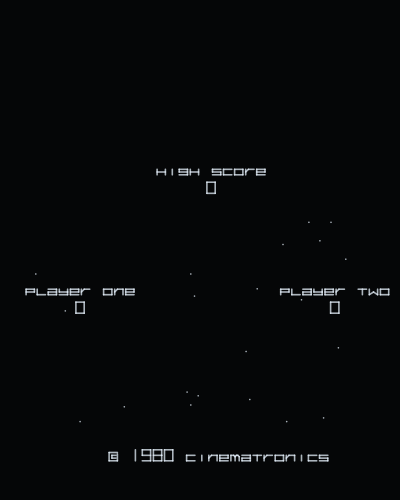
Playablev1.1
Star Castle
Cinematronics · 1980
by Daniel Ferrer
Its sound board through the jack for the first time, recorded from MAME's circuit-by-circuit model of it and driven word by word through the board's own shift register.
Runs on
- UVMC2✓
- Debug Cart✓
- Simulator✓
- Tested on hardware✓
Audio
- Music (PSG)–
- PCM–
- Jack✓
- Speech–
Details
- Original hardware
- Cinematronics CCPU
- Romset
- roms/starcas.zip
- Controls
- Pull the stick down for a coin and START (buttons 3 and 4 still insert a coin and start). The stick turns the ship left and right, button 1 fires, button 2 thrusts. TURN WITH BUTTONS (options screen): buttons 1 and 2 turn, 3 thrusts, 4 fires. On the web: Z, X, C, V and the arrow keys.
- Analog controls
- –
- Last update
- 2026-11-08
Changelog
- v1.12026-11-08
- A second control layout, TURN WITH BUTTONS on the options screen: buttons 1 and 2 turn left and right, 3 thrusts, 4 fires.
- Coin and start on the stick: pull it down for a coin and then START, in either layout.
- The options screen's CONTROLS page also says what the stick does.
- The romset can live in any folder of the card. The game looks in .roms/, then roms/, then searches the whole card, and remembers where it found it (.conf/<romset>.loc), so the next start goes straight there; if it is moved, it is searched for again.
- Settings go in .conf/ and romsets in .roms/: the UVMC2's menu hides folders whose name starts with a dot, so the card shows only the games. A card set up before keeps everything: the old config/ and roms/ are still read, and nothing is written to them any more.
- Without the romset on the card the screen says ROM FILE NOT FOUND and the name of the zip it wants.
- v1.02026-11-05
- First release.
- Sound through the jack: the background drone at each of its eight pitches, the thrust, the star, the shield hit, the castle's fireball and the player's fire, recorded from MAME's model of the board. The game sends the board 8-bit words through a shift register and a latch; they are decoded here as those two chips do.
- The cabinet's switches as MAME ships them, the service switch off: with all of them on, the board boots into its test pattern.
- The buttons count once they have been let go after power-on.
- The picture is the arcade's 1024 x 768 screen, fitted to the tube, at the game's 38 Hz.
- An options screen at start, after the Vectrex Studio intro: screen vertical or horizontal, refresh, brightness, controls (the buttons can be remapped, and the choice is saved) and calibration.
- Brighter: 96% of what it draws is at the board's dim level, which MAME puts at half the bright one -- dark on the Vectrex's tube. Raised to three quarters, checked on the console; the bright level is unchanged.