
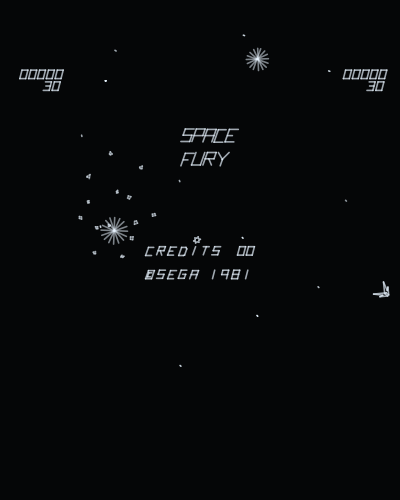
Playablev1.1
Space Fury
Sega · 1981
by Daniel Ferrer
Runs at 40 Hz with both its sound boards through the jack: the speech board emulated whole (its 8035 and SP0250) and the effects board recorded from MAME's netlist. Its recordings are a file next to the romset, roms/spacfury.jack.
Runs on
- UVMC2✓
- Debug Cart✓
- Simulator✓
- Tested on hardware✓
Audio
- Music (PSG)–
- PCM–
- Jack✓
- Speech✓
Details
- Original hardware
- Sega G80: Z80 (mz80)
- Romset
- roms/spacfury.zip
- Controls
- The stick left and right turns. Button 1 fires, button 2 thrusts, button 3 inserts a coin, button 4 starts. On the web: Z, X, C, V and the arrow keys.
- Analog controls
- –
- Last update
- 2026-11-08
Changelog
- v1.12026-11-08
- The bank of recordings (spacfury.jack) is read from .roms/ as well as roms/.
- The romset can live in any folder of the card. The game looks in .roms/, then roms/, then searches the whole card, and remembers where it found it (.conf/<romset>.loc), so the next start goes straight there; if it is moved, it is searched for again.
- Settings go in .conf/ and romsets in .roms/: the UVMC2's menu hides folders whose name starts with a dot, so the card shows only the games. A card set up before keeps everything: the old config/ and roms/ are still read, and nothing is written to them any more.
- Without the romset on the card the screen says ROM FILE NOT FOUND and the name of the zip it wants.
- v1.02026-11-05
- First release.
- The speech board emulated whole -- its 8035 and its SP0250 -- with the game's own speech ROMs: it talks as the cabinet does, at MAME's level.
- The effects board through the jack: eleven recordings of MAME's netlist, started and stopped when the game drives the board (thrust 7,307 against MAME's 7,231). They are too big for the image and travel as roms/spacfury.jack, read into the cartridge's PSRAM at start: copy it to the card with the romset.
- Runs at 40 Hz, at 300 MHz.
- Every vector visible: a coloured one is as bright as a white one, and the board's three colour levels are the Vectrex BIOS's own intensity steps. The dimmest were barely visible before.
- The cabinet's switches as MAME has them (they read 0: cocktail cabinet and odd lives), and the Z80 at the board's own 3.87 MHz instead of 3.0.
- The picture fitted to the screen.
- An options screen at start, after the Vectrex Studio intro: screen vertical or horizontal, refresh, brightness, controls (the buttons can be remapped, and the choice is saved) and calibration.