
Playablev1.1
Solar Quest
Cinematronics · 1981
by Daniel Ferrer
Its sound board through the jack for the first time -- the effects and the music phrases -- recorded from MAME's circuit-by-circuit model of it, and every button of the cabinet on the pad.
Runs on
- UVMC2✓
- Debug Cart✓
- Simulator✓
- Tested on hardware✓
Audio
- Music (PSG)–
- PCM–
- Jack✓
- Speech–
Details
- Original hardware
- Cinematronics CCPU
- Romset
- roms/solarq.zip
- Controls
- The stick turns the ship left and right; pulled down it fires the nova. Button 1 fires, button 2 thrusts, button 3 inserts a coin, button 4 is hyperspace and starts a game. On the web: Z, X, C, V and the arrow keys.
- Analog controls
- –
- Last update
- 2026-11-08
Changelog
- v1.12026-11-08
- The romset can live in any folder of the card. The game looks in .roms/, then roms/, then searches the whole card, and remembers where it found it (.conf/<romset>.loc), so the next start goes straight there; if it is moved, it is searched for again.
- Settings go in .conf/ and romsets in .roms/: the UVMC2's menu hides folders whose name starts with a dot, so the card shows only the games. A card set up before keeps everything: the old config/ and roms/ are still read, and nothing is written to them any more.
- Without the romset on the card the screen says ROM FILE NOT FOUND and the name of the zip it wants.
- v1.02026-11-05
- First release.
- Sound through the jack: both explosions, the thrust, the fire, the capture, the photon, the nuke, and the hyperspace, extra-ship and phase music, recorded from MAME's model of the board. The game feeds the board a 16-bit shift register with two latches, one for the effects and one for a music generator it plays note by note; both are decoded here as the chips do, and each music phrase, always the same in MAME, plays whole from its first note.
- The nova on the stick, pulled down: it had no button. Button 4 is hyperspace, which is also how the cabinet starts a game.
- The cabinet's switches as MAME ships them, the service switch off.
- The buttons count once they have been let go after power-on.
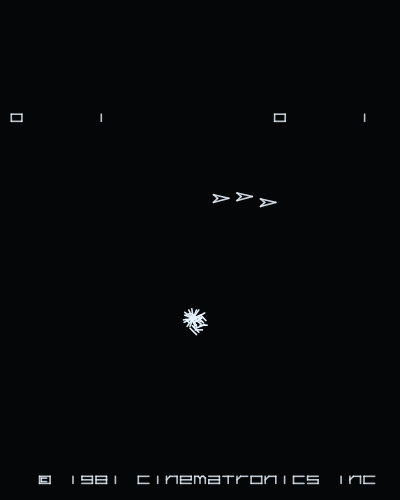
- The picture is the arcade's 1024 x 768 screen, fitted to the tube, at the game's 38 Hz.
- An options screen at start, after the Vectrex Studio intro: screen vertical or horizontal, refresh, brightness, controls (the buttons can be remapped, and the choice is saved) and calibration.