
Playablev1.1
Red Baron
Atari · 1980
by Daniel Ferrer
Its sound through the jack -- the POKEY and the board's crash, machine gun and nosedive circuits as MAME models them -- its switches read at last, and the picture fitted.
Runs on
- UVMC2✓
- Debug Cart✓
- Simulator✓
- Tested on hardware✓
Audio
- Music (PSG)–
- PCM–
- Jack✓
- Speech–
Details
- Original hardware
- Atari 6502 + mathbox, AVG
- Romset
- roms/redbaron.zip
- Controls
- The stick flies the plane: left and right roll, up and down pitch. Button 1 fires, button 3 inserts a coin, button 4 starts. On the web: Z, X, C, V and the arrow keys.
- Analog controls
- ✓
- Last update
- 2026-11-08
Changelog
- v1.12026-11-08
- The romset can live in any folder of the card. The game looks in .roms/, then roms/, then searches the whole card, and remembers where it found it (.conf/<romset>.loc), so the next start goes straight there; if it is moved, it is searched for again.
- Settings go in .conf/ and romsets in .roms/: the UVMC2's menu hides folders whose name starts with a dot, so the card shows only the games. A card set up before keeps everything: the old config/ and roms/ are still read, and nothing is written to them any more.
- Without the romset on the card the screen says ROM FILE NOT FOUND and the name of the zip it wants.
- v1.02026-11-05
- First release of this port (the earlier 0.1a on this page was Ralf Kornmann's).
- Sound through the jack: the POKEY, and the board's own circuits -- the crash, the machine gun, the nosedive squeal -- as MAME's model of them, ported line by line. The two levels measured against MAME on its own writes replayed (correlation 0.97).
- The cabinet's switches are read: English, 3 lives, bonus at 6k/20k/50k. They were not wired at all, and the game read whatever memory held.
- Coin 2 no longer held: the coin inputs are active low and idled as pressed.
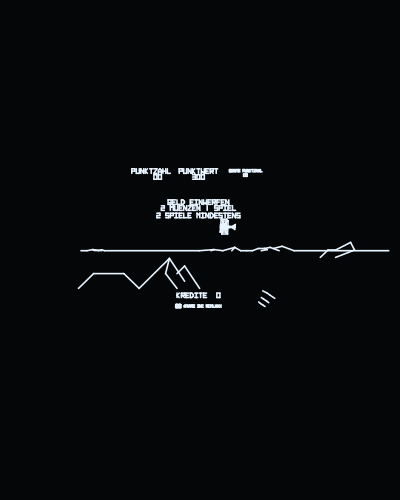
- The picture is MAME's 520 x 400 window, from Battlezone's measured one, fitted to the screen; what the vector generator draws past it is cut, as MAME does.
- An options screen at start, after the Vectrex Studio intro: screen vertical or horizontal, refresh, brightness, controls (the buttons can be remapped, and the choice is saved) and calibration.
- Fluid at 60 Hz: the cartridge runs at 300 MHz (at 150 the emulation and the drawing filled the whole frame, 56-57 fps), and one picture a frame -- the board runs at 61.5 Hz, so now and then two pictures fell into one frame, doubling the strokes and making the picture beat.